
Beyond assembly lines of the South African motor industry, supply chain resilience and shifts in the industry
Contents [hide]
- The economic impact of the South African motor industry
- The growing divide between locally manufactured and imported vehicles
- Nissan’s strategic shift, a signal of bigger challenges
- Chinese vehicle brands are reshaping the South African automotive market
- What South Africa can learn from Hyundai and Kia’s global growth
The motor industry in South Africa, like most industries, has undergone what one might call the “boiling frog” effect: slowly heating the water until it is too late for the frog to jump out. The Who Owns Whom report on the motor vehicle industry in South Africa illustrates how the combination of electricity supply instability, shifting global trade rules, slow technology adoption, and the influx of cheaper alternatives has affected this important industry. Manufacturers are no longer grappling with how many units they need to produce, but with how they will survive the volatile, low-carbon, and digitally driven future, whilst remaining competitive.
These challenges are slowly veering motor vehicle manufacturers away from a growth trajectory, jeopardising the future of this important industry in the country.
The Who Owns Whom report also highlights the strategic importance of this sector, which is one of the country’s most critical economic sectors. It contributed around 5.3% to GDP in 2025, employed approximately 500,000 people, and exported 414,000 vehicles. These figures reinforce the sector’s importance not only as a manufacturing base but also as a catalyst for industrialisation, investment and trade.
The economic impact of the South African motor industry
The South African motor industry generates wide-ranging economic activity across retail, infrastructure services, and manufacturing. Beyond vehicle manufacturing, the industry supports an extensive automotive supply chain. According to Statistics South Africa, tier-one suppliers provide OEM components to manufacturers, while tier-two suppliers provide specialised parts and materials to tier one. This integrated manufacturing network supports local manufacturing and industrial development in the sector.
The industry also sustains a vast downstream economy that includes car financing, insurance, fleet management, after-sales services, vehicle maintenance and repair, the supply of wearing components such as tyres, road building, car wash, fuel retail, spare parts, and the public-sector administration of car licensing, roadworthiness and testing centres, traffic fines that contribute materially to government revenue, not to mention the entire second-hand car market.
The growing divide between locally manufactured and imported vehicles
The schism emerging in recent years is between the decline in locally manufactured vehicles and a rise in imported vehicle sales, with a significant impact on the local economy, where policy interventions can make a difference.
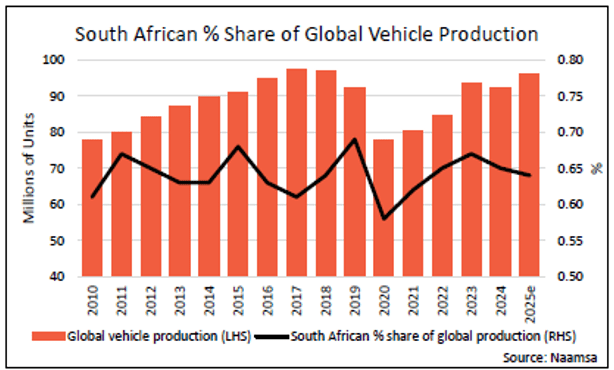
The downward trend in locally manufactured vehicles should not be underestimated, as it weakens local manufacturing, limits industrial investment, and harms employment and economic development.
Nissan’s strategic shift, a signal of bigger challenges
A symptomatic example of a strategic shift is Nissan Motor Corporation’s move, a brand that had been manufacturing in South Africa for decades. While Nissan will continue to sell cars in South Africa, the company decided to reduce its manufacturing exposure due to low production volumes. Reuters reported that Nissan has been increasing its focus on North Africa and on hybrid/EV, and that Morocco is part of that regional automotive ecosystem. Nissan’s e-Power hybrid technology was already available in Morocco, while South Africa was still being evaluated.
The consequence of a weak policy decision-making process by the South African government is that
Morocco has become far more attractive for automotive investment and has overtaken South Africa
as Africa’s largest vehicle manufacturing hub, because of:
- lower export logistics costs into Europe,
- stronger trade access,
- growing EV supply chains,
- competitive labour/productivity,
- and highly focused industrial policy support.
Other established brands, such as Stellantis, Renault and BYD, have also followed suit by building new plants in Morocco.
South African car manufacturing is losing on two fronts. Firstly, traditional flag bearers of locally manufactured premium brands have lost substantial market share. Data for 2025 indicate that luxury brand sales, mostly manufactured here, including Audi, BMW, Mini and Mercedes-Benz, fell from about 74,015 vehicles in 2014 to 23,881 in 2024, indicating a 68% drop in sales.
Secondly, imported vehicle brands are gaining market share, putting pressure on local car makers by offering cheaper alternatives.
Chinese vehicle brands are reshaping the South African automotive market
Suzuki, Haval and, very recently, a plethora of Chinese vehicles have joined Peugeot and Renault as bestsellers in the new car market, and none of them is manufactured in South Africa. According to the Who Owns Who report, in 2025, imports accounted for 83.2% of passenger car sales (422,464 units up from 78.0% in 2024) and 28.6% of LCV sales (143,639 units up from 22.6% in 2024).
On the other hand, exports of locally manufactured vehicles, which account for over 80% of total manufacturing, face rising trade tensions and geopolitical risks, creating vulnerability in the industry. The recent Trump-induced volatility has resulted in a drop in exports.
Suzuki, Chery, and India-manufactured Toyota Vitz feature among the most popular new car sales, whereas Mercedes and BMW only appearing in the second-hand, much cheaper car market as part of the most popular cars.
What South Africa can learn from Hyundai and Kia’s global growth
The South Korean Hyundai and Kia demonstrate how a good investment climate and policy certainty can foster growth from humble beginnings. Over three decades, Hyundai and Kia have grown from small players into the largest automotive manufacturers. The conglomerate has become the largest global motor vehicle manufacturer, essentially from nowhere 30 years ago.
South Africa does not have to become the largest manufacturer, but it needs to protect, strengthen and grow the competitiveness of this strategic industrial sector.
Contact us to access WOW's quality research on African industries and business
Contact UsRelated Articles

BlogCountries RetirementSouth Africa
Why the strong South African retirement funding industry still leaves most unprepared
South Africans face mounting financial pressures and that does not assist the current challenge of the low household savings rate of 1.2% of disposable income, according to the Wall Street Financial Services website. This is reported against a backdrop of only about 6% of citizens saving enough for a comfortable retirement.
BlogCountries South AfricaTransportation & Logistics
The South African Courier, Express and Parcel Services: A shining star of the e-commerce industry
E-commerce growth, mobile technology and changing buying patterns have powered South Africa’s Courier, Express and Parcel (CEP) Services industry turning it into a critical link in the digital economy.
BlogCountries ManufacturingManufacturingMozambique
How the tobacco industry in Mozambique evolved from cash crop to a strategic commodity
The tobacco industry in Mozambique has always been an integral part of the country's economic activity, serving as a subsistence crop bartered among its communities.