
Launch of the international trade module on WOWEB
International trade is a critical driver of South Africa’s economy, shaping growth, employment, investment, competitiveness, and business success across virtually every industry. Whether a company imports, exports, or operates solely in the domestic market, global trade flows affect costs, pricing, supply chains, market opportunities, and competitive dynamics.
International Trade module on WOWEB
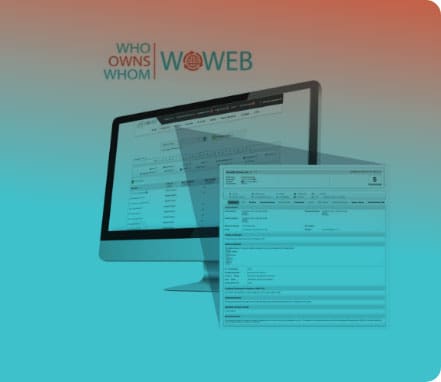
You may have noticed the International Trade menu on WOWEB. The new module provides insights into South Africa’s trade with Africa and the rest of the world, broken down by region, country and product. The underlying data is available for download in spreadsheet format and is supported by predefined graphs and tables.

This value-added feature provides subscribers with access to total trade data, as well as trade by country and product. Combined with WOW’s industry research, the new trade data functionality provides a deeper understanding of the forces shaping industries and companies in an increasingly interconnected global economy.
We hope this enhancement will further support market intelligence, business development, investment, and strategic decision-making. The information provides a high-level view of South Africa’s trade flows and you are welcome to contact WOW if you require more in-depth analysis.
Access to the International Trade module
The International Trade Module is available at an additional charge for WOWEB subscribers, other than those with multi-user contracts, for whom access is included. If you would like to consider subscribing to the module, please let us know, and we will be in touch to set up a review of the dataset so that you can assess its relevance and value to your organisation.
Africa: low-hanging fruit for South African companies
The African market represents relatively low-hanging fruit for South African companies and has long been recognised by forward-looking businesses that have pursued regional expansion through foreign direct investment (FDI).
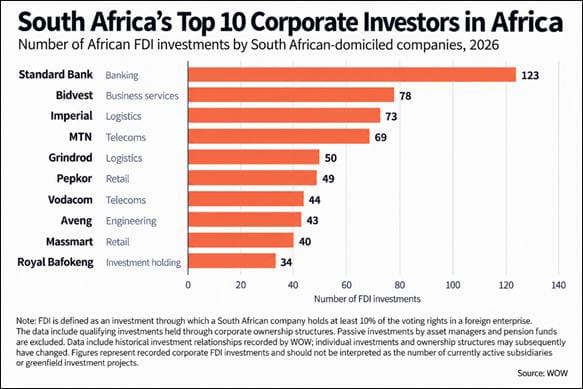
The following table, extracted using the WOWEB Report Generator, ranks the top 10 South African-domiciled companies with FDI investments in Africa. Consistent with the International Monetary Fund (IMF) definition, FDI refers to an investment through which an investor acquires at least 10% of the voting rights in a foreign enterprise. Standard Bank leads the ranking by a substantial margin, with retailers, construction, logistics and telecommunications companies prominent among the remaining investors.
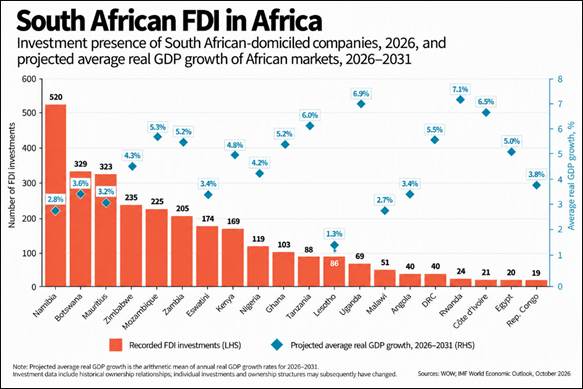
The table below shows the African countries that have historically attracted the greatest interest from South African companies, with SADC markets predominating. Overlaying GDP growth rates provides an additional indication of market momentum and can help identify countries where expanding economic activity may create future trade and investment opportunities.
Contact us to access WOW's quality research on African industries and business
Contact UsRelated Articles
Newsletters
Nuclear energy is no longer the villian
South Africans have a knack for not letting a good crisis go to waste. Six years ago, while grappling with the external threat of COVID-19, we also faced an internal,...

Newsletters
AI Market Trends
WOW’s recently published report on AI Market Trends in South Africa, which is available on WOWEB, offers a comprehensive overview of developments in this rapidly evolving sector. Readers may find...

Newsletters
Unsung Heroes
Not enough recognition is given to the people who manage knowledge centres in corporate organisations, partnerships, educational institutions, government departments, and agencies. When I started my career in the information...