
The not-so-sweet future of South Africa’s Sugar Manufacturing Industry
Contents [hide]
- The impact of Tongaat-Hullet on the South African sugar industry
- South Africa in the global sugar market
- Production Trends and Industry Stability
- Shifts in demand and the rise of alternative sweeteners
- Rethinking the sugar industry strategy for South Africa
- Diversification as a more sustainable path for the sugar industry
On the one hand, the sugar industry is fighting against the tide, with consumption of sugar products decreasing by about 4 to 5% a year in most countries, including South Africa, except in Asia, where there was a slight increase of 1%, mainly due to population growth. This means that potential expansion of export markets has become more challenging with overproduction in the major exporter countries, inevitably leading to stronger competition from the big boys worldwide.
On the other hand, the industry plays an important role in economic growth and job creation. Given its labour intensity, the industry needs to explore opportunities to pursue innovative ways to self-preserve and grow.
The impact of Tongaat Hulett on the South African sugar industry
The Tongaat Hulett saga is too big to ignore as it is a dominant market player, with a market share of 30-35%. It highlights some lessons on the importance of governance, transparency and ethical conduct. Its activities are a reminder that businesses must operate in the best interest of the country and its stakeholders, including canegrowers.
The crisis significantly destabilised South Africa’s sugar industry, affecting canegrowers, mill operations and regional economies. Its financial collapse disrupted supply chains and tarnished investor confidence, prompting restructuring efforts while highlighting the need for stronger governance oversight.
Currently, these issues are still being ventilated in the courts, and hopefully the story ends well for the canegrowers, the South African sugar industry and the people and companies that depend on it. South Africa must remain capable and competitive to preserve its export markets.
South Africa in the global sugar market
South Africa is a net exporter of sugar and among the 20 largest global exporters. Brazil was the largest in 2024, exporting 38.2Mt and Thailand was second with 4.1Mt. France and Germany together exported larger quantities than South Africa. South Africa was 12th, exporting about 700,000t in 2024, mainly to African countries, Mauritius, Mozambique and Nigeria. Besides African Namibia was the major importer followed by Malaysia, Botswana, South Korea, Zimbabwe, the UK, Madagascar, Mozambique, Eswatini and the US.
The worldwide decline in consumption is attributed to growing health concerns and is accentuated by governments’ introduction of sugar taxes aimed at tackling diabetes prevalence. Research from the United Nations University World Institute for Development Economics Research (UNU-WIDER) shows that the sugar tax implemented in South Africa in 2018 led to a 33% reduction in sugar consumption from taxable beverages within two years, as referenced in Who Owns Whom’s report on The Manufacture of Sugar in South Africa.
Production Trends and Industry Stability
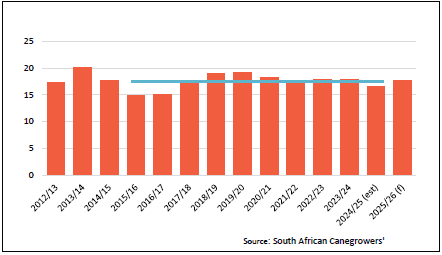
The graph here shows that sugar production declined by 7% to 1.94Mt in 2024/25, from 2.08Mt in 2023/24, but output in 2025/26 is expected to increase by 6%, supported by improved cane yields and sugar processing facility upgrades. Over the long term, there has not been a significant decline in production. Lower consumption has been offset by growing population numbers, keeping overall consumption at a reasonable level.
Shifts in demand and the rise of alternative sweeteners
What the sugar tax has caused is a significant shift by food and beverage processing companies, which, according to the Who Owns Whom’s report, account for 49% of sugar sales. These companies pay the sugar tax and have increasingly been substituting sugar with alternative sweeteners. Notable is stevia leaf extract, a natural alternative which is 50 to 300 times sweeter than sugar but contains no calories.
Rethinking the sugar industry strategy for South Africa
The South African Sugar Value Chain Master Plan 2025-2030 aims to build a competitive, sustainable, and diversified sugarcane value chain by 2030 that promotes transformation and job creation. Trade and market protection will be strengthened through SACU harmonisation and tariff measures, with commitments to grow local market offtake.
It is posited that the emphasis of the plan on market protection, tariff harmonisation and commitment to local market uptake misses the economic realities of a continued focus on healthier lifestyles in the face of the association of high sugar consumption with rising obesity and diabetes, happily supported by governments through sugar taxes. This will, as shown and mentioned above, put a damper on the expansion of sugar consumption.
Diversification as a more sustainable path for the sugar industry
The Who Owns Whom report mentions that sugarcane is a flexible crop that can be used to produce other commodities. Sugar juice, molasses and fibre waste extracted from sugar production can be used to manufacture bioethanol, electricity, animal feed, bioplastics and food additives.
These are among the more promising avenues to support higher sugarcane production. Innovation and alternative uses for sugarcane production, beyond direct or indirect human consumption in food and beverages, are key to a successful future.
Ultimately, for South Africa to remain competitive, the sugar industry needs to be preserved and evolve beyond traditional sugar manufacturing. Like all industries, it needs to adapt and embrace more resilient market trends.
Contact us to access WOW's quality research on African industries and business
Contact UsRelated Articles
Blog Manufacturing
The power of the mill: Food security and the evolution of South Africa’s grain sector
Contents [hide] Flour and grain mill products are central to food security and the backbone of the agro-processing ecosystem. Grains are a critical input for baking, brewing, animal feed, and...
BlogCountries ManufacturingSouth Africa
South Africa’s Plastic Manufacturing Industry: Innovation, sustainability and investment opportunities
Contents [hide] Plastic is a versatile, cost-effective, and useful product with a wide array of applications in almost every industry, from food to transportation, packaging, and manufacturing. Technological innovations and...

BlogCountries ManufacturingSouth Africa
Manufacture of basic chemicals in South Africa, a strategic pillar for industrial development
Contents [hide] Basic chemicals, or commodity chemicals, are fundamental building blocks used for making complex products. They are typically produced in large volumes, used as raw materials, and are generally...