
Beyond the grave, and the evolution of culture in the funeral services industry in South Africa
Contents [hide]
- Funeral services before and after democracy in South Africa
- The rise of funeral insurance and financial products in the funeral industry
- Economic & Social Impact
- Urbanisation, Cost Pressures and Changing Burial Practices
- Digital Transformation and Modern Service Models
- The future of funeral services in South Africa
Funeral services and related industries have undergone a gradual transformation since the advent of democracy in 1994 from a community-based, culturally driven sector into a complex, multi-billion-rand industry that blends tradition, business, finance, technology, and social innovation. Today, funeral services sit at the intersection of culture, economics and modernisation, reflecting both the country’s diversity and its developmental trajectory.
In the past, funerals were largely managed by the deceased’s family, with support from friends and family, on a voluntary basis. Today, the practice has become a structured industry comprising event organisers, caterers, corporate players, financial products, digital platforms, and professionalised service models. This requires investment to cover hiring marquees, elaborate setups with catering and decorations, and red carpets at the church, home and cemetery. While the event itself has been modernised, funerals remain deeply rooted in South Africa’s cultural and spiritual identity.
Funeral services before and after democracy
In the mid-20th century, stokvels emerged as burial societies in South Africa, where members pooled funds to cover very basic funeral costs such as the procurement of an animal to be slaughtered, a coffin, a grave, and sometimes two buses to transport community members attending the event. Stokvels gradually morphed into funeral insurance as communities sought more structured and reliable ways to manage the high costs of funerals, transitioning from pooling contributions informally to formalised operations, with record-keeping adopted and standardised premiums, and contractual benefits.
Post-1994, broader financial inclusion, urbanisation, and access to banking services reshaped the sector, which has become more formalised, regulated, and commercialised. The more corporatised funeral parlours like AVBOB, Icebolethu, Doves and B3 Funerals expanded into townships, rural areas and peri-urban communities, offering structured packages, standardised pricing, and integrated services.
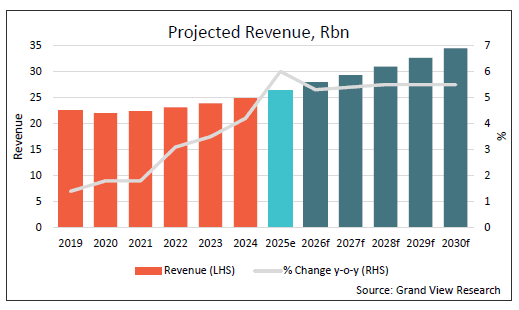
According to the Who Owns Whom report on funeral services and related industries, South Africa is considered the fourth most expensive country in the world for funerals. There are an estimated 15,000 funeral parlours and about 75,000 operators, many of whom work informally.
The report indicates that industry revenue is expected to grow from R24.9bn in 2024 to R34.5bn by 2030, at a CAGR of 5.4% from 2025, according to Grand View Research.
While traditional burial remains dominant, more people are exploring cremation and eco-friendly burial options due to environmental concerns, changing cultural attitudes and limited cemetery space in cities
The sector has grown and continues to create employment, developing supply chains (coffins, tombstones, transport, catering, florists), and stimulating small business development across communities.
The rise of funeral insurance and financial products in the funeral industry
Insurers and banks are now also actively offering funeral policies that trace their roots to these traditional stokvels, blending communal solidarity with modern financial regulation to ensure families can afford dignified burials while reducing financial strain.
The report quoted the Association for Savings and Investment South Africa (ASISA), which reported that combined policies rose from 12.2 million in 2022 to 15.1 million in 2023, with growth especially strong at 23.8%. Policies rose further to 15.8 million in 2024 (up 4.6%). Total combined funeral insurance premiums rose from R38.0bn in 2023 to R40.3bn in 2024, an increase of 6.1%, following a substantial increase of 37.7% or R10.4bn from 2022.
Funeral insurance transformed how families prepare for death — shifting from reactive fundraising to proactive financial planning. This has driven the growth of large funeral groups, insurance-linked service providers, and vertically integrated business models that combine insurance, funeral services, and burial products.
Economic & Social Impact
The industry supports thousands of jobs in a broad ecosystem across funeral homes, casket and tombstone manufacturing, florists, transport, and insurance. Funerals are also central to South African social life, with significant expenditure on fashion and catering. It has become a norm for attendees to buy fashionable outfits when attending funerals. With the expansion of related financial products, the industry’s footprint in the formal economy is important in terms of GDP contribution.
This integration makes funeral services a critical contributor to township and local economies, supporting both formal businesses and informal livelihoods.
Urbanisation, Cost Pressures and Changing Burial Practices
Urbanisation has significantly reshaped funeral practices. Land scarcity, rising burial costs, and municipal cemetery shortages have driven a steady increase in the consideration of cremation, particularly in urban centres.
While traditional burial remains culturally significant, especially in rural and township communities, practical realities are changing preferences. Cremation, once culturally resisted in many communities, is increasingly being considered due to affordability, land constraints, and logistical simplicity.
Digital Transformation and Modern Service Models
Technology has introduced a new dimension to funeral services. Livestreamed funerals, digital memorial events, online funeral notices, and electronic documentation are becoming more common, particularly since the pandemic.
Digital tools now support booking systems, client management, insurance claims processing, and remote participation in funeral services. This has expanded access for diaspora families and improved operational efficiency for service providers.
The funeral industry reflects similar changes to how other businesses are being run, with the physical aspects blended with digital infrastructure, platforms, and service innovation.
The future of funeral services in South Africa
Moving forward, the sector is expected to undergo greater consolidation and formalisation, driven by increased regulation and compliance.
While the industry is driven by emotion, culture, and tradition, it continues to advance and is becoming more sophisticated, moving towards eco-friendly and sustainable burial options, the introduction of digital funeral services, innovation in memorialisation models, and deeper integration with financial services, which can contribute to the professionalisation of township-based operators
Contact us to access WOW's quality research on African industries and business
Contact UsRelated Articles

Blog South AfricaTransportation & Logistics
South Africa’s air transport and aviation’s re-mergence, its struggles and opportunities.
Contents [hide] The Who Owns Whom report on air transport and aviation ground-handling services in South Africa highlights the paradox of how a powerful economic enabler that drives tourism, trade,...
Blog Public administration and defence compulsory social security
South Africa’s defence capability, performance, partners and rising global risks
Contents [hide] The Russia-Ukraine war is demonstrating how agile, technology-driven warfare dominated by drones, missiles and precision systems is starting to undermine traditional on-the-ground troops and heavy equipment. South Africa’s...
Blog Manufacturing
The power of the mill: Food security and the evolution of South Africa’s grain sector
Contents [hide] Flour and grain mill products are central to food security and the backbone of the agro-processing ecosystem. Grains are a critical input for baking, brewing, animal feed, and...