
South Africa’s Healthcare Challenges and the Future of Universal Health Coverage
Contents [hide]
Healthcare is a vital cog in any economy. When the nation’s workforce is healthy, there is more economic activity, businesses do well with less absenteeism and highly productive employees. Healthy people in the economically active population constitute the labour pool that contributes positively to economic processes. The degree of productivity and efficiency determines the performance and progress of the economy as a whole, and also determines the level of rewards for the labour input and the creation of wealth. Hence, governments play a critical role in the healthcare sector.
The current reality of South Africa’s health coverage
The current reality of South Africa’s healthcare inequality leaves most of its population behind. The well-resourced private sector serves just 15% of the 63 million-plus population who can afford expensive medical coverage. The stretched public health care system must carry the rest. The “missing middle” of working people are looking for better medical care, but earning too little to afford medical aid accounts for around 6 to 10 million adults, or up to 45% of the working population.
South Africa’s healthcare system compared to other countries
While some countries like the UK lean towards high public sector involvement, others such as the US tend to minimise public sector involvement in operational aspects. There are numerous reports about the inefficiency of the National Health System (NHS) in the UK such as long waiting times and a high degree of dissatisfaction. However, the improved life expectancy and vitality of its population can be attributed to the NHS. The US, in contrast, offers high-quality healthcare in an efficient yet costly manner, and it can be so expensive that a health event can cause financial hardship. Many developed countries have found a middle ground, where medical care is affordable and assured, even for poorer households. These mostly have a universal public sector-run financing system tagged onto private sector investments. It is important to note that all of these countries have low unemployment rates and, as a result, can raise sufficient contributions to fund their healthcare.
South Africa, with a broad unemployment rate among the economically active population of over 40%, is struggling to move away from the current unequal system to achieve universal coverage. The signing into law of the National Health Insurance NHI Act, while intended to address inequality, has triggered legal battles from the private sector.
Shortage of skills and staffing challenges in South Africa’s health system
South Africa has a shortage of 27,523 professionals in public facilities, underscoring the severity of public hospital staff shortages South Africa. Yet, the irony is stark: over 1,800 qualified medical graduates remain unemployed, begging the question: why are South African doctors unemployed?
The absurdity of having unemployed qualified doctors in South Africa, despite a low doctor-to-population ratio, is mainly due to government’s inefficiency and mismanagement of health budgets – leading to underfunded public facilities, and an inability to absorb available medical professionals into the system.
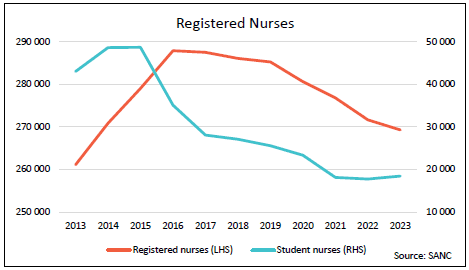
A government initiative to shift nursing education from cost-free, legacy, hospital-based programmes to the more expensive higher-education framework, as well as college closures, has reduced training capacity for several years, shrinking the pipeline of student nurses. This has reduced the ratio of nurses to the population. The Who Owns Whom report on the health sector in South Africa illustrates this very well in the adjacent graph.
The cost of healthcare in South Africa
Generally, the cost of healthcare services is high, especially in the private sector. In the public sector, services are offered at a minimal price, but the system is overburdened, resulting in poor quality of service and an inadequate standard.
The government has plans to level up the standard of service by forcing the private sector to continue to provide the same quality service but at a lower cost, through the NHI. Enhancing public sector services will inevitably increase the cost of provision, as extensive investment, coupled with a sustainable human resources management plan, will be required. Successful implementation of this policy remains questionable.
The current plan raises doubts about the capacity and capability of the government to pull this off, given its poor track record of efficiently running any SOE or government department.
The recently revealed level of corruption at Tembisa hospital reveals the depth of the rot and affirms the justification for extreme scepticism.
As it stands, taxpayers already finance the public health sector, but have to incur further costs by contributing to medical aid to access quality private healthcare. They do the same with education, security, and other services.
Where to from here for this vital sector of the economy
Achieving the vision of an impartial universal health coverage is important and urgent, but it will depend on concrete reforms. Government must prioritise the professionalisation of state-run facilities, which would improve budget management and restore accountability.
Reviewing training capacity for nurses and providing incentives for unemployed doctors to be absorbed into underserved areas would immediately strengthen the system’s backbone. Most of all, government has to rebuild public trust by taking decisive actions to address the malfeasance in the administration and invest in infrastructure. This will determine whether the NHI becomes a catalyst for transformation. South Africa’s health sector and the well-being of its people depend on how Treasury handles the challenges and weaknesses that have been exposed. It is not impossible.
Contact us to access WOW's quality research on African industries and business
Contact UsRelated Articles
BlogCountries Human health and social work activitiesSouth Africa
Healthcare funding in South Africa – medical aid schemes coverage versus universal coverage
Contents [hide] Medical aids have been in the crossfire since the NHI Bill was signed into law by President Cyril Ramaphosa in May 2024. Even without this threat, medical aids...

BlogCountries Human health and social work activitiesSouth Africa
The cleaning products industry – trends and sustainability
Learn about South Africa's cleaning products: sustainability trends, brand dynamics, SME opportunities, growth outlook, exports & eco-packaging shifts.

BlogCountries Human health and social work activitiesSouth Africa
Is the South African healthcare sector in crisis?
Contents [hide] Introduction Information on the healthcare sector is plentiful and summarised in the latest WOW report on the healthcare sector in South Africa. Besides the issue of the relatively...