
Copper Re-emerges as a Strategic Mineral for South Africa
As countries transition toward renewable energy decarbonisation, they are shifting investment towards modern electricity infrastructure for electric vehicles (EVs), which require energy storage, and towards clean energy technologies. These developments have brought copper back into the spotlight in the critical minerals mix, particularly for EVs, given its foundational role as a resource for the digital, low-carbon economy.
Copper production in South Africa
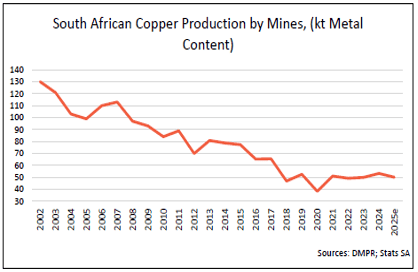
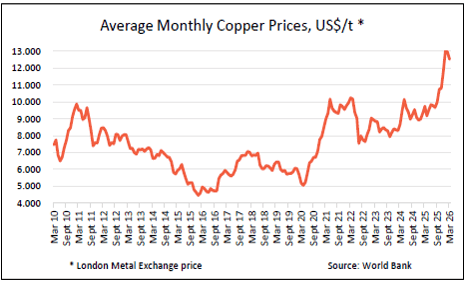
South Africa seems to have missed the worm, as the saying goes: “the early bird catches the worm”. Those operating copper mines with expansion capacity have reaped the benefits of the surge in copper prices. The two graphs, courtesy of the Who Owns Whom report on the Mining of Copper in South Africa, illustrate how South Africa has missed the opportunity to capitalise on the rise in copper prices, with the country’s copper production declining despite higher copper prices.
South Africa’s opportunity in the growing copper market
The Who Owns Whom report on copper mining also highlights how Gwede Mantashe, the Minister of Minerals and Petroleum Resources, missed the opportunity to list copper as a “high-criticality mineral”. While copper’s price might not have risen as spectacularly as cobalt and lithium, it has surged to record highs this year, according to the IEA website, briefly exceeding USD 14 500 per tonne (intraday) in January 2026, having only passed USD 12 000 per tonne for the first time in December 2025. And now, the US-Iran war and spiking oil prices are seeing the beginning of another bump in EV vehicle sales and consequent high demand for battery metals, the next boom cycle for battery minerals.
The good news is that the metal is highly versatile, spanning traditional construction, power grids, and artificial intelligence (AI) data centres, and has multifaceted attributes such as excellent electrical and thermal conductivity, corrosion resistance, ductility, and recyclability. This, combined with its persistent structural supply deficit, protects the metal from bouts of oversupply and makes it less prone to the high volatility of commodity cycles. The CME Group, the exchange for metals futures and options, characterises copper as more of a long-term electrification and infrastructure metal than a pure cyclical commodity.
How South Africa differs from the developed countries
As mentioned, the industry applies conservative principles that differ markedly from those of
Western nations that operate a pay-as-you-go (PAYG) system, in which current social security
contributors fund current state pensions, with only a small fraction of private pensions actuarially funded. This explains South Africa’s 83.2 pension assets-to-GDP ratio, which towers over the global average of 33.9%. High assets are not necessarily a sign of a successful and satisfactory pension system but only indicate a different funding model.
The need to interpret these percentages is starkly relevant when Who Owns Whom reports that only about 6% of South Africans are on track for a comfortable retirement, compared with 40-60% in the OECD, with some countries reaching 70-80% (Netherlands and Denmark).
This should encourage South Africa to review and promote reinvestment in copper mining. Mining investment is long-term and expensive, and although the higher price of copper appears to have established a higher floor with less volatility, other countries, such as Zambia, known for its mineral-rich copperbelt, have experienced turbulence in the past, so caution remains important.
Long-term outlook for copper
Although other miners around the world are also expanding copper mines, copper prices are generally expected to hold steady.
South Africa’s success in copper mining will depend less on the availability of the mineral and more on the country’s ability to improve infrastructure, attract investment, encourage exploration an develop downstream beneficiation capabilities.
The existing copper mines in South Africa are intent on increasing capacity and are undertaking major expansion investments at Palabora Copper, as well as reopening copper mines at Copper 360 in Rietberg and at Orion Minerals in Prieska.
The global energy transition presents a significant opportunity for the South African copper mining industry, but to capture this value, several issues must be addressed, including the ongoing illicit market for the metal. It is reported that state-owned enterprises and municipalities have lost billions of rands annually to copper cable theft, causing economic damage amounting to hundreds of billions. This has crippled logistics, including Transnet’s rail lines, and has led to losses of more than R1 billion from theft at Sibanye-Stillwater in recent years.
The slow processing of prospecting and mining right applications by the DMPE is another issue that needs to be addressed to get the country’s copper mining back on track.
As the WOW report noted, the majority of copper concentrate production continues to be refined locally, strengthening local value chains and reducing reliance on external processing capacity. While not as glamorous as gold, copper is a valuable mineral with significant economic spin-offs for South Africa and therefore worth pursuing a little more vigorously by our government.
Paving the way for copper mining in South Africa
As copper continues to emerge as one of the most strategic minerals powering the global energy transition, South Africa has to combat copper theft and improve the efficiency of awarding prospecting rights to reposition itself as a competitive player in the new technology space and attract mining investment.
Contact us to access WOW's quality research on African industries and business
Contact UsRelated Articles
BlogCountries MiningNamibia
Mining in Namibia, still the cornerstone and a powerhouse in the global mineral race.
The country might be small in economic terms, but it is certainly punching above its weight compared to other African countries endowed with more resources.

BlogCountries MiningSouth Africa
South Africa’s manganese industry, powering the global energy transition
South Africa holds the world's largest manganese deposits. Discover how high electricity costs, beneficiation gaps, and battery demand are shaping the sector.