

South Africa’s defence capability, performance, partners and rising global risks
The Russia-Ukraine war is demonstrating how agile, technology-driven warfare dominated by drones, missiles and precision systems is starting to undermine traditional on-the-ground troops and heavy equipment. South Africa’s armament industry is still Africa’s largest and most advanced, known for innovation (drones, armoured vehicles, electronic systems) and it maintains a strong export market, despite post-apartheid downsizing and budget fluctuations.
From military dogma to battleground reality
The “Will for Peace” exercise from 9 – 16 January 2026, hosted in South African waters (Simon’s Town), which involved BRICS Plus nations, with primary participants being South Africa, China, Russia, Iran, and the United Arab Emirates, raised a few eyebrows, particularly given the timing in relation to geopolitical events. While it is claimed that the focus was on maritime security, including the protection of shipping lanes, the controversy emanated from the inclusion of Iran and Russia, despite reported presidential orders to the contrary, which led to a board of inquiry to investigate whether the military (SANDF) defied presidential authority.
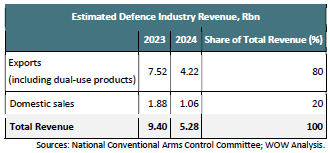
As stated in the Who Owns Whom report on South African defence and related industries [found here] the South African National Defence Force was established in 1994 with the integration of the apartheid-era South African Defence Force, the military wings of liberation movements (including Umkhonto we Sizwe and the Azanian People’s Liberation Army), the armed forces of the former homeland territories (Transkei, Bophuthatswana, Venda, and Ciskei), and KwaZulu-Natal’s self-protection units.
SANDF budget cuts and operational readiness
Over the past 30 years, the country’s defence industry has declined from being a globally competitive, vertically integrated defence manufacturer to a niche exporter in global defence value chains, its competitiveness steadily being eroded by a general decline in domestic procurement and loss of skills, despite pockets of advanced capability.
The phrase “no plan survives first contact with the enemy”, most famously attributed to field marshal Helmuth von Moltke, a 19th-century German military strategist, emphasises that plans must be flexible because unforeseen circumstances will always force changes.
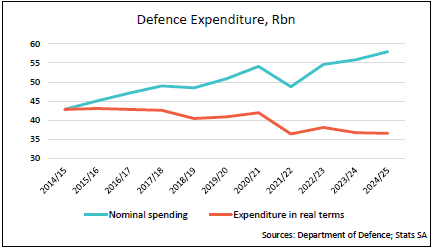
South Africa’s defence plans involve gradually increasing funding while prioritising maintenance and modernising equipment. This will be a tough “battle” of a different kind, given the fiscal pressures and industrial capacity constraints.
South Africa’s defence industry is also highly dependent on exports. The continued decimation of this industry, as reported in the Who Owns Whom report, is illustrated in employment numbers of 100,000 back in 1994 having been reduced to about 20,000 in 2025. This is due to steadily declining sales.
Political shift and the resultant defence trade realities
Worldwide, there is a massive increase in defence spending, but the tragedy is that South Africa is missing out on that opportunity due to lack of capacity and technologically-competitive weapons due to fiscal challenges. The lack of demand from the SANDF due to the country’s defence industry not keeping up with innovation and developments has contributed to this state of affairs.
Political alliances and positioning will also influence opportunities to strike deals with countries looking for defence procurement.
The budget curtailment and allocations have led to significant degradation, with a large proportion of military equipment out of commission. The Who Owns Whom report provides eye-opening information showing that budget allocations go mainly to wages.
| Country | % of budget for wages |
| South Africa | 65% |
| US | 25% |
| UK | 27% |
| France | 35% |
| China | 40% |
| Russia | 10%(Low transparency) |
| Israel | 40% |
The inevitable inference from the latest global conflicts is that staff numbers do not equate to military superiority or efficiency. Military superiority, or at least a measure of equivalence, depends on technology and equipment capability and capacity.
The defence minister’s intention for government to gradually increase its budget allocation to SANDF from less than 1% to 1.5%, still below the 2% expected from NATO members, is a step in the right direction, but perhaps the allocation of SANDF’s budget needs fundamental revision, with a much larger part going to investment in technological improvement, equipment and armament.
Jane’s Defence Weekly magazine analysis corroborates that while South Africa retains some defence capabilities on paper, both budget constraints and declining equipment availability are impeding the SANDF’s operational effectiveness. One might add a lack of strategic direction. South Africa needs to fix this.
South Africa needs to rebuild its defence ecosystem, which will require strategic clarity, political will and long-term investment. Without such reform, the country risks being marginalised in both global defence markets and its ability to safeguard its own sovereignty.
Contact us to access WOW's quality research on African industries and business
Contact UsRelated Articles
BlogCountries Public administration and defence compulsory social securitySouth Africa
South Africa’s security industry: A puzzle worth unravelling
No one can build his security upon the nobleness of another person” – Willa Cather Contents [hide] Security is an integral part of society, yet it is often taken for...

CountriesNewsletters Other service activitiesPublic administration and defence compulsory social securitySouth Africa
WOW 2017 Highlights in Numbers
Despite a challenging economic environment, Who Owns Whom had a successful 2017. - 21 local and international corporations became new Who Owns Whom clients. - WOWEB introduced more than 30 new features based on customer requests.

CountriesNewsletters Financial and insurance activitiesPublic administration and defence compulsory social securitySouth Africa
Implications of the Financial Intelligence Centre Guidance Note 7 Published on October 2nd 2017
In the fight against money laundering and terrorist funding, the intention of the FIC’s recently released Guidance Note 7 is to support accountable institutions and supervisory bodies in the implementation of the Financial Intelligence Centre Act, 2001 (Act No. 38 of 2001) (the FIC Act).